
projects
role: founder, curator, coordinator
Sense Ability was a six-week project housed within the crypt beneath St Pancras New Church on Euston Road. Through intimate quiet spaces, enveloping soundscapes, hand-crafted scents from locally foraged plants, material craft exhibitions, an apothecary, reading spaces, and a cultural programme of 73 events, the project invited visitors to re-root into presence, deep listening, and intentional pause.
Bringing together more than 50 practitioners, from land workers, cultivators, and traditional knowledge keepers to designers, artists, and musicians, the project cultivated a space for cross-disciplinary knowledge exchange.
Its daily programme of workshops, conversations, screenings, performances, and shared material practices explored relationships between land, body, craft, food, and ecology.


role: founder, organiser
In 2020, Masha founded and curated the Zeitgeist Project, an interdisciplinary festival that ran for three years and brought together theatre, experimental music, craft, food culture, and visual arts. The project created a platform for local and international artists, musicians, designers, and makers, cultivating a space for experimental artistic practices, interdisciplinary dialogue, and a polyphony of voices across creative communities.

role: education fascilitator, theatre practitioner, design coordinator
A collaborative theatre-making project developed with the Indigenous Shuar community in Ecuador, exploring relationships of interdependence between human and more-than-human life, drawing from Indigenous knowledge systems and lived relationships with the forest.

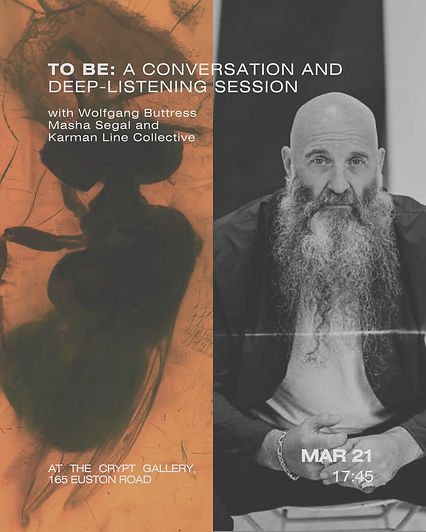
role: organiser, host, speaker
A live conversation with Wolfgang Buttress, exploring the ways of approaching art and design as a means of extending and amplifying human potential. Together, we reflect on the role of the built environment in shaping our everyday lives, and how working with, rather than against, natural systems might help us imagine and cultivate different futures, both individually and collectively. The talk gently transitions into a deep-listening session of TO BE, the debut album by Karman Line Collective.
The listening experience will be accompanied by a living scent-scape made from bee propolis - a precious creation offered by bees and a medium Wolfgang Buttress works with, creating a sensorial space where sound, matter, and ecology converge.
role: design vision
THE CONE: CONSTRUCTION PROPOSAL, LATVIA A site-responsive proposal exploring the expressive and structural potential of rammed earth as both material and method. Conceived as a conical form inspired by the surrounding pine forests, the structure embeds itself within the meadow landscape. At its centre, a small water basin is fed by rainwater collected through suspended chains. The circular interior invites shared presence, encouraging visitors to gather, sit, and orient themselves around water as a point of reflection. The project also highlights local plant species valued for their medicinal, symbolic, and aesthetic qualities. Through material, form, and atmosphere, the structure explores how architecture can cultivate attentiveness to landscape.
role: producer, design vision
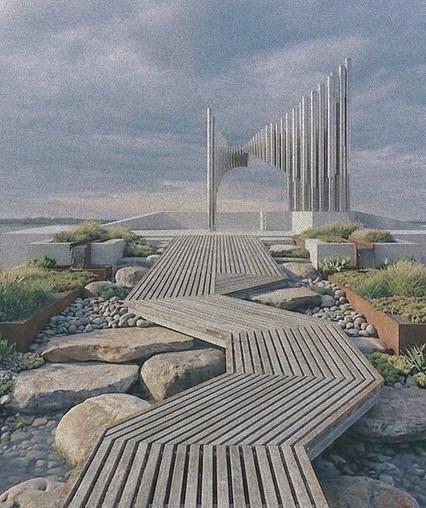
PLACEMAKING SITE:
LIEPAJA CULTURE CAPITAL OF EUROPE (SPECULATIVE)
A proposed site-responsive placemaking project exploring the intersection of cultural, historical, and ecological heritage through an immersive wind-activated sculpture. Inspired by Liepāja’s historic mechanical organ, the work was envisioned as a resonant sculptural form that would generate sound as wind moved through its organ-like pipes, transforming the city’s most elemental force into a shared sensory experience.
Conceived as a community-led initiative, the proposal included co-creation workshops with local residents alongside design and architecture students, embedding collective authorship into the development of the site. Envisioned as a contemporary pilgrimage destination, the project aimed to encourage visitors to journey toward an environment that renders the invisible perceptible, deepening awareness of the relationship between human presence and the natural landscape.
role: co-founder, organiser
RE:CONNECTION was a series of intimate interdisciplinary gatherings held in home-like settings, bringing together pioneering voices from diverse practices through discussions, exhibitions, screenings, performances, and immersive experiential learning experiences.

role: builder, student, filmmaker
SAVVALA RESIDENCY (LATVIA) :
RAMMED EARTH PAVILLION
A two-week rammed-earth residency in Savvala Savage, led by Kaarel Kuusk, resulted in the construction of a contemporary earth pavilion using soil sourced directly on site. Working with plywood formwork and traditional ramming techniques, the project explored material immediacy. The pavilion is considered among the first contemporary rammed-earth structures in the Baltics.


role: partner, co-organiser, design vision
An intentional gathering to explore what it means to be human on this earth at this time, and cultivate our capacities to bring healing to ourselves, one another and this world.
role: design vision
HASTINGS REGENERATIVE PUBLIC ART COMMISSION (2025) This proposal consists of two interconnected components that reflect Hasting's ecological and material heritage through public realm interventions. One is a series of sculptural plant vessels with each reflecting one of Hastings’ defining ecosystems: the meadows, woodlands, and cliffside/coastal zones. Each planting scheme is housed within a form that reflects the qualities of its environment while engaging with the plants indigenous to the ecosystem. The second component is a large-scale sculptural installation in Wellington place square designed as both a gathering space and a visual echo of the cliffs that rise behind the Wellington Place. The proposed form draws from natural geological textures while remaining permeable to light and sight lines. It includes areas for seasonal planting, integrated seating, and the potential for community events such as performances or fairs. This structure acts as a central node for reflection, interaction, and symbolic cohesion. The proposal invites collaboration with local artisans, horticulturist, and community members, ensuring that each piece reflects Hastings and is actively shaped by its people.
role: design vision
OSAKA WORLD EXPO PROPOSAL LATVIAN/ LITHUANIAN PAVILION The Latvia–Lithuania Pavilion proposal for the Osaka World Expo was developed by our team, Human Collective, following an invitation from the pavilion developers to contribute a creative concept. Our studio was approached in recognition of its four-year research into Latvian heritage and traditions, undertaken through the development of the feature documentary Latvian Myth. Building on this research, the proposal translates key cultural narratives, rituals, and relationships to landscape into an immersive spatial experience. The following materials present selected excerpts and visual directions from the project.
role: design vision
PETT LEVEL OBSERVATORY HASTINGS, 2025 A proposal to transform the disused Pett Level Observatory into a site-responsive cultural space, developed in conversation with the local authority. Drawing on the site’s layered history and exposed coastal setting, the project brings together diverse heritage crafts to create a destination rooted in landscape, material, and shared cultural use.